
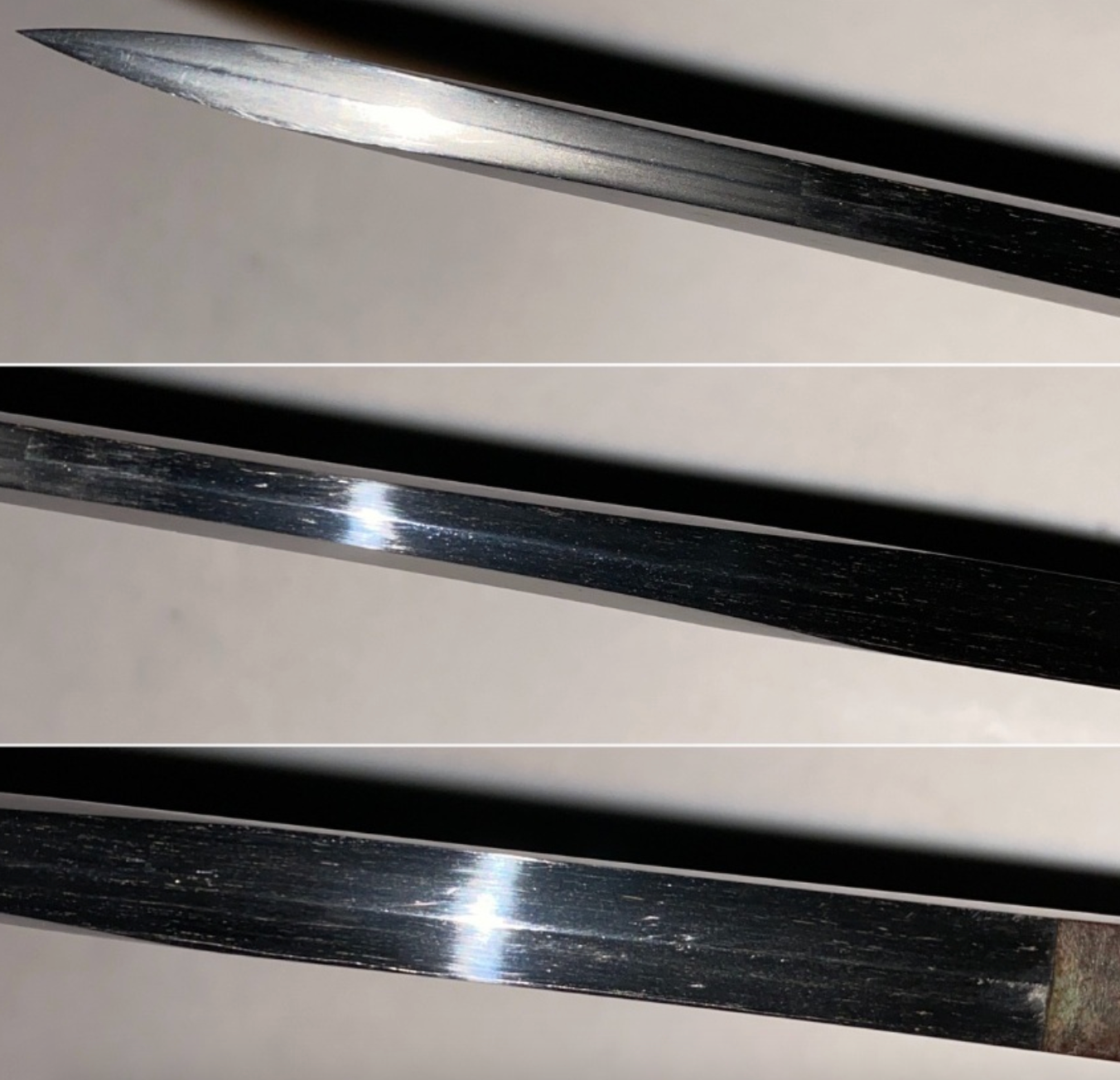
I believe that the soundness of a Japanese sword depends on whether it retains the condition it was in when it was made.
A sword whose Kasane has become thin due to sharpening is not a sound sword.
Kasane is the most important factor.
Since sharpening reduces the thickness, the thicker the Kasane, the sounder the sword. However, since the thickness of Kasane varies depending on the era and the swordsmith, one cannot simply say that a sword is unsound just because it is thin.
Even when we simply say “Kasane,” the thickness of a Japanese sword differs between the base and the tip. Therefore, when evaluating Kasane, we generally refer to the thickness around the base of the habaki. If this area is thick, the sword is sound.
Naturally, the habaki is crafted to fit the thickest part of the blade. Therefore, when the habaki is attached, the presence of a gap between the habaki and the blade indicates that the blade has been worn down through sharpening.
In any case, Kasane is the most significant indicator of a sword’s sound condition.
As a general guideline for ideal Kasane thickness in swords:
0.7 cm or more is considered thick
0.7–0.6 cm is thick or average
0.6–0.5 cm is average.
Share:
Have you heard of “KATANAKIZU”?
What kind of sword should you choose as your first one?