
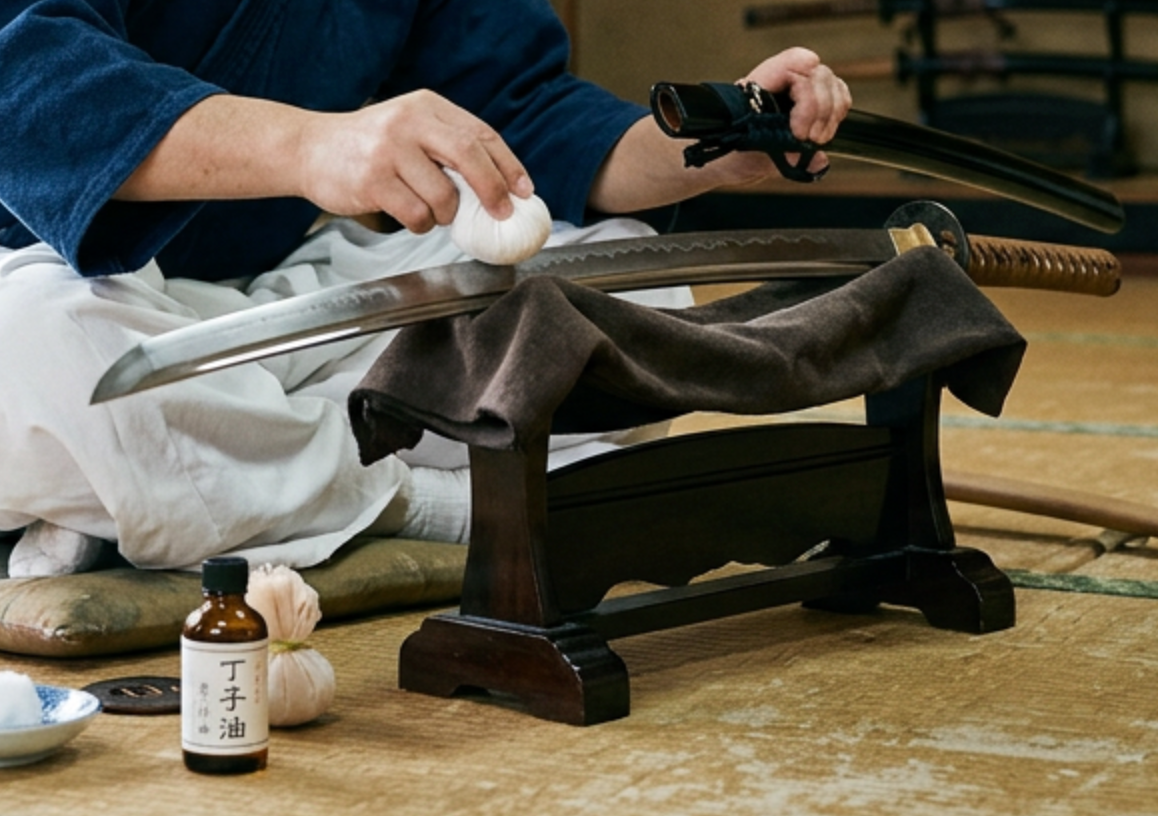
How to Care for a Japanese Sword
Tamahagane, the material used for Japanese swords, is an extremely high-purity iron, but it possesses a highly rust-prone nature. When moisture or old oil accumulates inside the scabbard, it creates a vicious cycle where rust progresses even further from there.
To keep your Japanese sword in good condition for years to come, it requires maintenance at least 2-3 times a year.
1.Store the Sword in a White Scabbard

Whenever possible, store the sword in a white scabbard (resting scabbard).
Storing it in its full mount makes it difficult to achieve a tight seal, risking air exposure to the blade surface. This can cause rust.
2.Maintenance of the White Scabbard

If the white scabbard is old and damaged, we recommend splitting it open to clean the interior. For external dirt, lightly shave the surface around the affected area.
Newly made white scabbards still contain significant moisture. This can lead to future dimensional instability or, without diligent care, become a cause of rust.
Older white scabbards, however, have wood that has dried out considerably. This loss of moisture makes them considered the most suitable for storing the blade.
3. Avoid Using Powder

In the past, when maintaining swords, powder and clove oil were used, along with paper thoroughly rubbed with Mino-no-kami. However, this is not recommended today. While traditional maintenance methods may be suitable for appreciating the old-fashioned feel of a Japanese sword, they are not advisable for preserving your cherished blade. The powder is made from the fine dust of an inner-cloud whetstone.
Applying this powder to the blade and rubbing it with clove oil creates countless microscopic scratches invisible to the naked eye.
After years of continuous maintenance on a blade that was carefully polished, the once sharp, white edge gradually becomes dull and grayish, and the metal itself appears somewhat blurred.
This is thought to occur because the fine powder from the polishing powder mixes with the oil and penetrates into the grain patterns like itamae, mokume, or masame, obscuring the view of the metal.
4.100% alcohol is recommended.

We now recommend maintenance with 100% alcohol or gasoline, high-quality sewing machine oil (i.e., machine oil), and soft tissue paper without unnecessary additives.
To care for the blade, fold the tissue paper, spray alcohol or gasoline on it, and wipe the back of the blade. This will completely remove old oil in one or two passes.
After checking the blade, soak cotton with machine oil and wipe the back of the blade with it.
Carefully wipe off any excess oil on the blade with a paper towel, making sure that the oil layer remains as thin as possible.
If you apply too much oil, drops may form inside the white sheath. If these are not removed over the years, they can leave stains inside the sheath. Therefore, apply the oil sparingly and evenly.
Share:
The Charm and Role of the Tsuba
The Main Differences Between Tachi, Katana, Wakizashi, and Tantō