When appreciating Japanese swords, don't beginners sometimes feel at a loss, unsure of what exactly to look for?

In most cases, seeing the sleek, curved, and imposing “form” of a Japanese sword should make you think, “Japanese swords are cool.”
And wouldn't most people find the hamon (most often a painted hamon) beautiful?
This alone shows that the “form” and “hamon” are key elements of appreciation.
Then, when you actually purchase a Japanese sword and hold it in your own hands, you'll likely notice a pattern-like appearance on the flat surfaces of the blade.
Because Japanese swords are forged from wafu iron, the iron's texture becomes visible.
It resembles the pattern found on Damascus knives.
This is precisely the aesthetic element known as the “skin” (hada/skin).
Observing the skin, you'll also notice faint shadow-like patterns emerging on the blade surface.
This is called “reflection” (Utsuri) and is another key aesthetic element.
These elements collectively form the aesthetic appreciation of Japanese swords.
Summarizing the elements:
① Form (Shape)
Refers to the overall design of the Japanese sword.

② Hamon (Blade Pattern)
The artistic quality of the blade pattern.
The expression techniques of the pattern, known as “nioi” (boiling) and “nioi” (smell).
The patterns within the blade, known as “kakari” (work).

③ Jigane (Hada/Skin)
The artistic quality of the iron pattern (skin) on the blade.

④ Utsuri (Reflection)
The artistic quality of the shadow patterns appearing on the flat surfaces of the blade.

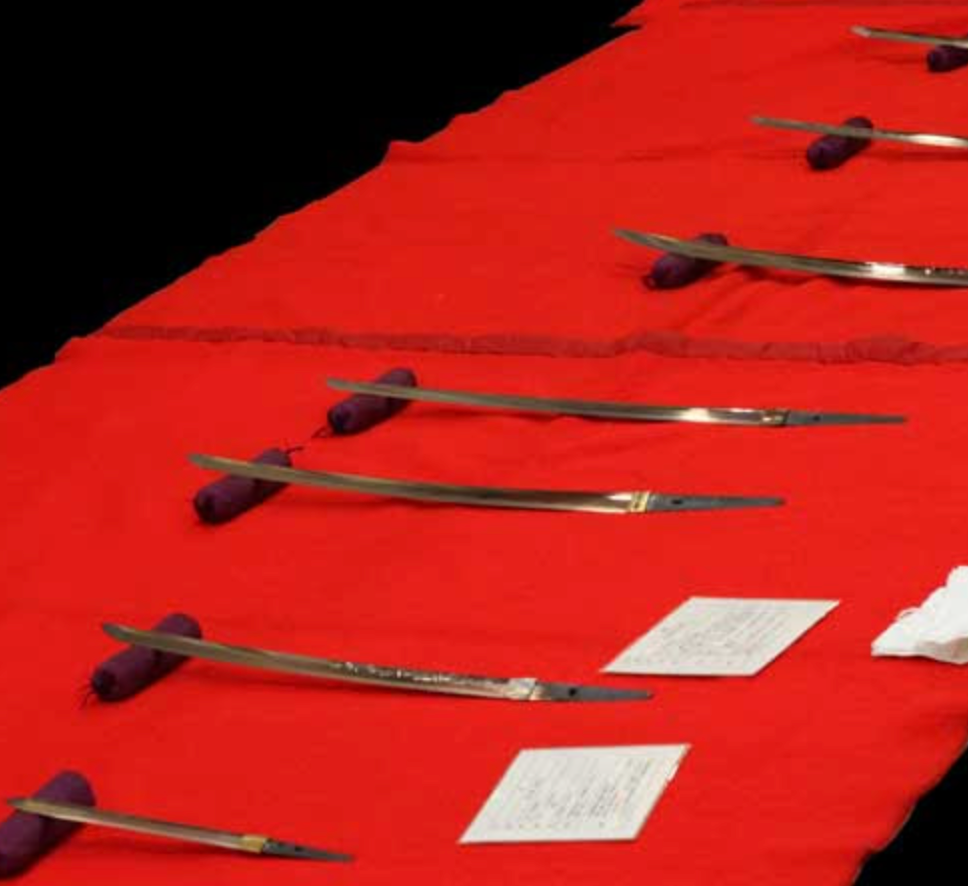
In practice, when viewing Japanese swords at an appreciation event, it is common to observe them in the order of ① to ④.
Share:
Why might overseas buyers feel uneasy about purchasing a Japanese sword?
The Charm and Role of the Tsuba