Main Differences Between the Tachi, Katana, Wakizashi, and Tantō
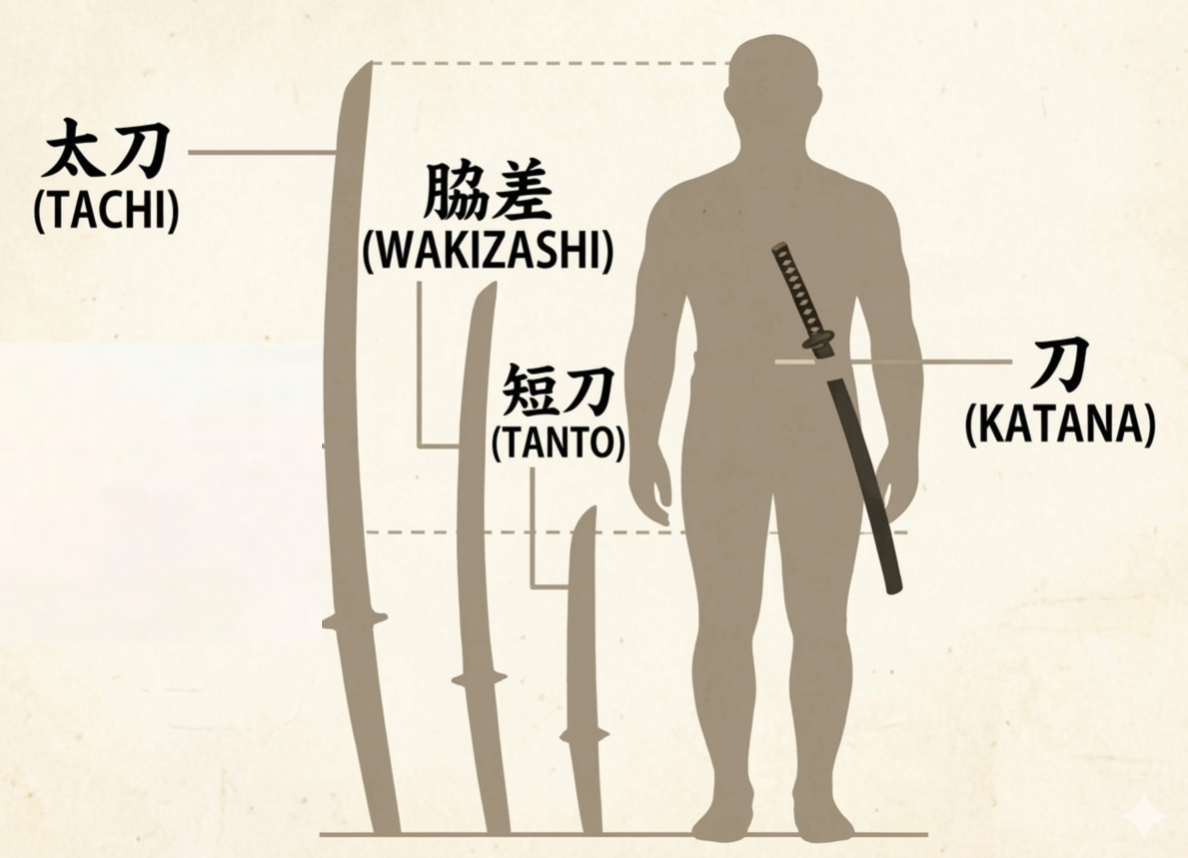
The main differences are “length” and “purpose.”
“Tachi”
75 cm or longer; carried with the blade pointing downward, suspended from the sash by a cord.
Used for mounted combat. Features a deep curve.

“Katana”
75 cm or longer, worn with the blade facing upward.
Designed for foot combat. The mainstream style during the Edo period.
Blade faces upward. Can strike immediately upon drawing.

“Wakizashi”
30 cm to less than 60 cm.
Designed for foot combat. The mainstream style during the Edo period.
“Tantō”
Less than 30 cm.These evolved according to the era and combat style.
Tachi vs. Katana
History: The tachi developed primarily for mounted combat before the Kamakura period, while the katana developed for group infantry combat from the Muromachi period onward.
Inscription (Mei): On a tachi, the maker’s name is engraved on the side that faces outward when worn; on a katana, it is engraved on the side that faces outward when sheathed. Consequently, the curvature and orientation of the inscription are reversed.

Wakizashi vs. Tantō
Length: The dividing line is 30 cm; blades longer than this are called “wakizashi,” while those shorter are called “tantō.”
Purpose: The wakizashi was essential as part of a samurai’s “set of two swords” (daisho). The tantō was used for self-defense or as a “yoroi-dōshi” (armor-piercing blade) to stab through gaps in armor.

Share:
How to Care for a Japanese Sword